None
Adds nothingIt still works. Dairy milk brings a mild sweetness of its own.
A misugaru latte is misugaru, a Korean powder of roasted grains and beans, mixed with milk and a little honey. One glass takes a 20 g scoop of powder, 2 teaspoons of honey, 3/4 cup of milk and about two minutes. There is no coffee in it unless you add a shot.

Also a 12 oz glass and a handheld frother or a spoon. Without the scoop, weigh the powder if you can. Recipes that measure by the kitchen tablespoon usually call for 2 to 3.
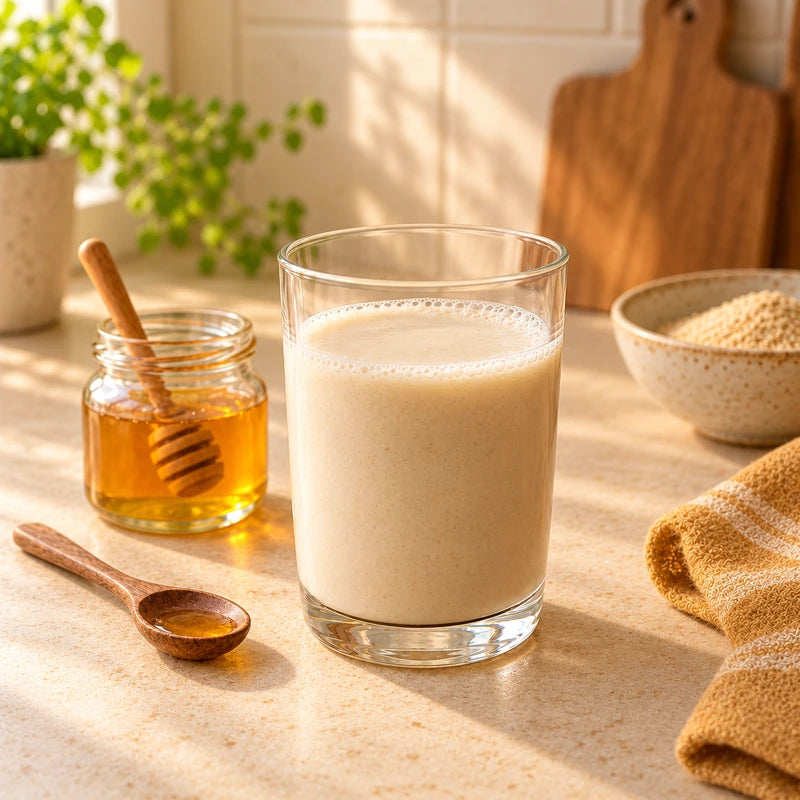
About 2 minutes. The paste comes first, because it is what keeps the drink smooth.

Put the powder in a 12 oz glass and add 2 to 3 tablespoons of warm water.

Froth with a handheld frother, or stir hard with a spoon, for about 10 seconds, until it is smooth with no dry spots.

Add the honey and the pinch of salt. Honey loosens in the warm paste and blends in. In cold milk it sinks and stays in a lump.

Add the cold milk and stir or froth for a few more seconds. Taste it. For a sweeter glass, loosen another teaspoon of honey in a spoonful of warm water and stir that in.

Drop in 4 to 6 ice cubes and drink.

About 4 minutes. Same ingredients, without the ice.
Plain misugaru is not sweet. It tastes nutty and lightly malty, like toasted cereal, and a little honey rounds it out. Honey and sugar are the usual sweeteners in Korean recipes.
It still works. Dairy milk brings a mild sweetness of its own.
Lightly sweet.
Sweet enough to taste like a treat, with the grain flavor still in front.
Closer to a cafe drink. Many Korean home recipes use about this much.
The pinch of salt is a common addition in Korean home recipes. It makes the honey taste sweeter without adding more. Sugar works in place of honey, teaspoon for teaspoon, and is a little less sweet.
The powder has no sugar. The sweetness comes from the honey and the milk. Each row is the whole glass: one scoop, 2 teaspoons of honey and 3/4 cup of that milk.
| Made with | Calories | Protein | Fiber | Sugar |
|---|---|---|---|---|
| Whole milkThe creamiest glass. A little under half of the sugar is lactose from the milk. | 225 | 10 g | 3 g | 21 g |
| Unsweetened soy milkAbout as much protein as dairy milk. | 175 | 9 g | 4 g | 12 g |
| Unsweetened oat milkTastes of oats, which suits the toasted grain. | 200 | 5 g | 3 g | 16 g |
| WaterThe older way to drink it. Lighter and nuttier, and strictly not a latte. | 115 | 4 g | 3 g | 11.5 g |
Without the honey, take off 43 calories and 11.5 g of sugar. The powder itself, per 20 g scoop of Misu: 70 calories, 4 g protein, 3 g fiber, 0 g sugar. Milk and honey figures are from USDA FoodData Central, worked out from each entry's per 100 g values and rounded, calories to the nearest 5. Lower-fat milk works the same way and tastes lighter, and half milk and half water also works. Cartons vary, so check yours.
Put the warm water, powder and honey in a jar with a lid and shake. Add the milk, shake again for 15 seconds and pour over ice.
Use two scoops to 1 cup of milk, with twice the warm water and 1 tablespoon of honey, in a 16 oz glass. That is close to the strength many Korean home recipes use. Two scoops of powder are about 140 calories, 8 g protein and 6 g fiber.
Use a full cup of milk, or half milk and half water, in a 16 oz glass.
Make the paste in a measuring jug with 2 scoops, 4 to 6 tablespoons of warm water, 4 teaspoons of honey and the salt if you are using it. Stir in 1 1/2 cups of milk, then pour over ice in two glasses. Stir the jug before the second pour.
Some cafes add a shot of espresso, and you can pour one over the finished drink at home. That adds caffeine: USDA lists about 63 mg in a 1 fl oz shot. The powder itself has 0 mg.
The powder is ground grain and bean. It does not dissolve the way sugar does, so it sinks to the bottom after a few minutes. That is normal. Stir or swirl the glass and keep drinking.
When dry powder lands in a full glass of cold liquid, the outside of each lump gets wet first and seals the dry powder inside. The paste step fixes that. A few tablespoons of warm water wet all of the powder at once, so the milk only has to thin a paste that is already smooth.
Yes, with any plain misugaru. The powder numbers on this page are for Misu, which is brown rice, white rice, hominy corn, black bean and barley, roasted and milled fine, with nothing added. It contains gluten from the barley. Some other mixes, instant latte sticks in particular, come already sweetened, so check the label and cut or skip the honey if sugar is listed.
It is best made fresh. The powder settles as the glass sits, so if you mix it ahead, keep it in the fridge and shake or stir it before you drink.
The powder figures are Misu's label. The rest are USDA FoodData Central entries, read 12 November 2026:
The recipe uses Misu, our own misugaru.
See Misu→Last updated 12 November 2026